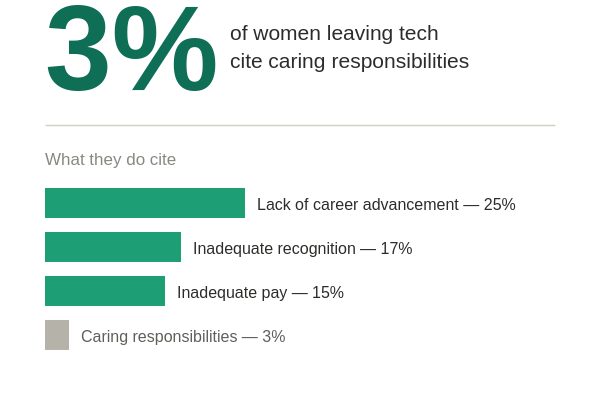
Three percent.
That’s the proportion of women who cite caring responsibilities as their primary reason for leaving STEM.
I know it’s wrong. Not just because of the research — but because I was one of the women who inflated it.
When I left my first engineering role, I told my director I was leaving to be with my partner and possibly start a family. It was a lie. I was leaving because that same director once called me out of a meeting with my own team to do his filing. Because I’d been paid a grade below my male colleagues for doing exactly the same work — with additional “development opportunities” instead of equal pay. Because my route to promotion depended not on my performance but on how this director felt about me.
I said “family” because I knew he wouldn’t argue with it. He wouldn’t try to keep me. He’d nod sympathetically and wish me well. And I wanted out cleanly — because even if I’d fought and won, even if I’d got the promotion, I’d have found myself back in the same position in a couple of years. The system wouldn’t have changed. Just my job title.
I suspect I’m not the only woman who’s done this. Which means the 3% isn’t just low. It’s probably lower than the data shows — because some of that 3% were women like me, giving the answer that was easy to hear instead of the one that was true.
The 2025 Lovelace Report surveyed 500+ women in UK tech. When they asked why women had left or were considering leaving, the top answers were:
→ Lack of career advancement: 25%
→ Inadequate recognition: 17%
→ Pay inequity: 15%
Caring responsibilities came in at 3%.
Yet walk into most boardrooms and suggest that women are leaving, and the first response is still some version of: “Well, it’s hard to balance work and family.” It’s a comfortable explanation. It places the cause outside the organisation. It means nobody in the room has to change anything.
And here’s the problem: your exit interview data is probably confirming this comfortable story — because women have learned that telling the truth on the way out doesn’t change anything. They do the same calculation I did: is it worth the fight? Will it make any difference? And when the answer is no, they say “family” and leave quietly.
Which means your retention strategy is built on data that your own culture has contaminated.
So what actually works?
Three things the evidence says make a measurable difference:
If you’re a manager:
- Have a real conversation about progression — before someone hands in their notice. Not the annual appraisal. A specific, honest conversation with each of your experienced women about where they want to go, what’s in the way, and what you’re going to do about it.
- Sponsor, don’t just mentor. Mentoring is advice from the sidelines. Sponsorship is putting your reputation on the line — recommending someone for the stretch project, pushing their name into the promotion conversation when they’re not in the room.
- Look at your own pay data. Not the company-wide report — your team, right now. Are your women on the same grade as the men doing the same work?
If you’re a woman in STEM:
- Know your number. Over 60% of experienced women earn below benchmark. Data turns a grievance into a negotiation.
- Stop giving the comfortable answer. If you’re leaving, consider telling them the truth. For the woman who comes after you.
- Talk to other women in your field. Isolation accelerates attrition.
The 3% statistic exposes a feedback loop. Women leave for structural reasons. They cite personal ones. Organisations justify doing nothing structural. Breaking the loop starts with honest data — and organisations prepared to act on what they hear.
Sally Purdie CEng FIMMM — Chartered Engineer | Change Consultant | STEM Retention Coach
Sources:
- Oliver Wyman & WeAreTechWomen (2025). The Lovelace Report
- McKinsey & LeanIn (2025). Women in the Workplace